
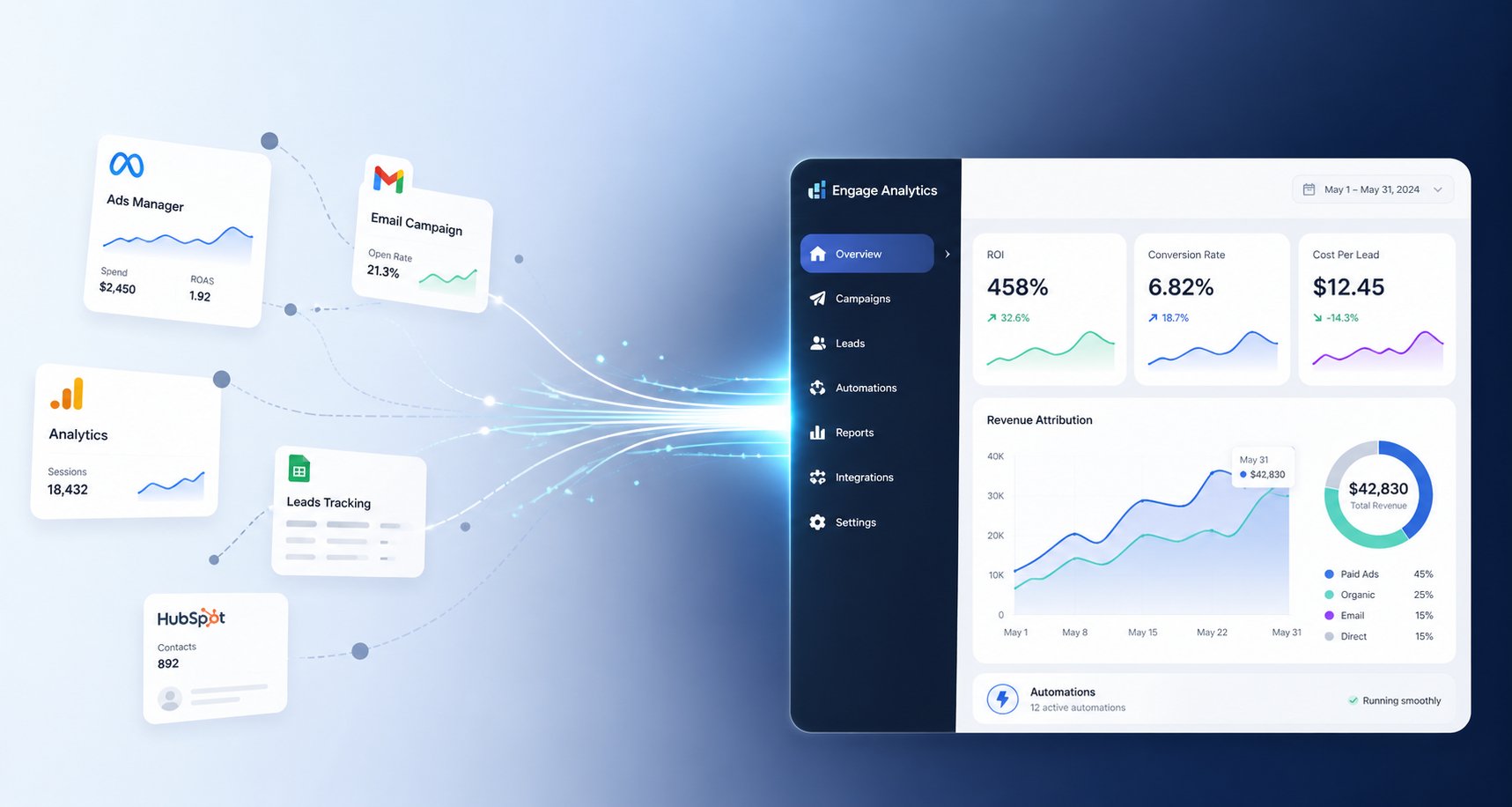
Attribution in Marketing: Understanding What's Actually Working for Your Business

Introduction
You've invested in paid ads, sent out email campaigns, published blog posts, run social media promotions, and maybe even attended industry events. A lead converts. A sale closes. Now comes the question every marketer eventually has to answer: what actually made that happen?
That question is at the heart of marketing attribution – one of the most important, and most misunderstood, concepts in modern marketing. Without it, you're essentially flying blind, spending money and hoping for the best.
What Is Marketing Attribution?
At its core, marketing attribution is the practice of assigning credit to the various marketing interactions a customer has before completing a desired action – whether that's filling out a form, making a purchase, or requesting a demo.
Think about a typical customer journey. A prospect sees your brand mentioned in a LinkedIn post, clicks a Google ad a few days later, gets retargeted on Instagram, opens a nurture email, and finally books a call through your website. Which of those touchpoints gets the credit? All of them played a role – but in different ways and to different degrees. Attribution is the discipline that helps you answer that question with data instead of gut feeling.
In today's digital landscape, where customers move fluidly between devices, platforms, and channels before making a decision, understanding the full journey is not a luxury – it's a necessity.
Why Attribution Matters in Marketing
The case for attribution is not just academic. It has direct, measurable consequences for how you allocate budget, how you build campaigns, and ultimately how you grow revenue.
Budget optimisation. When you know which channels and campaigns are genuinely driving revenue, you can shift spend away from underperforming tactics and double down on what actually works. Without attribution, you risk pouring money into channels that look productive on the surface but contribute little to actual conversions.
Smarter campaign strategy. Attribution reveals not just what converts, but what influences the decision-making process at each stage of the funnel. It gives you a complete picture of the customer journey rather than just the final click, allowing you to build campaigns that nurture prospects effectively from awareness all the way through to conversion.
Accountability and reporting. Marketing teams are increasingly expected to demonstrate the tangible business impact of their work. Attribution provides the evidence — connecting spend to pipeline and revenue in a way that leadership and clients can understand and trust.
Identifying gaps and opportunities. Sometimes attribution exposes blind spots: channels working harder than anyone realised, or budget quietly wasting away with no measurable return. It surfaces these inefficiencies before they compound.
The Different Attribution Models
Not all attribution works the same way. There are several models, each with different logic for assigning credit across the customer journey.
First-Touch Attribution gives 100% of the credit to the very first interaction a customer had with your brand. It's useful for understanding how people discover you, but it ignores everything that happened after that initial contact – including all the nurturing that actually built the relationship.
Last-Touch Attribution does the opposite, crediting the final touchpoint before conversion. It's simple and widely used, but it dramatically undervalues the awareness and nurturing activities that made that final click possible. A customer who saw ten of your touchpoints before converting didn't just decide on a whim at the last moment.
Linear Attribution distributes credit equally across every touchpoint in the customer journey. It's more balanced, but treats a casual blog visit the same as a high-intent product page interaction – which doesn't always reflect reality.
Time-Decay Attribution gives more credit to touchpoints that occurred closer to the conversion. The logic is that recent interactions had the most influence on the final decision. This works particularly well for shorter sales cycles where recency genuinely matters.
Position-Based (U-Shaped) Attribution gives heavier credit to the first and last touchpoints – typically 40% each – and distributes the remaining 20% across the middle interactions. It acknowledges both the moment of discovery and the moment of decision, while still recognising the journey in between.
Data-Driven Attribution is the most sophisticated model available today. Rather than following fixed rules, it uses machine learning to analyse your actual conversion data and distribute credit based on how each touchpoint genuinely contributed to outcomes. It's the most accurate model available, though it requires sufficient data volume to work effectively.
The most important thing to understand is that there is no single perfect model. The right choice depends on your business, your sales cycle, and your marketing mix. Many mature marketing teams use more than one model simultaneously, comparing the outputs to build a richer understanding of performance.
The Tools That Make Attribution Work
Understanding attribution as a concept is one thing – actually implementing it requires the right tools. Each platform in your marketing stack plays a specific and important role in capturing, processing, and interpreting attribution data.
Google Analytics 4 (GA4)
GA4 is the foundational analytics layer for most businesses. It tracks how visitors arrive at your website, what they do once they're there, and whether they convert. Its built-in data-driven attribution model makes it significantly more powerful than older analytics platforms for understanding complex, multi-step journeys. GA4 allows you to see assisted conversions – touchpoints that contributed to a sale even if they weren't the last click – giving you a far more honest picture of channel performance. It also integrates with Google Ads, allowing you to connect ad spend directly to on-site behaviour and conversions.
CRM Platforms (HubSpot, Salesforce, and others)
Your CRM is not just a place to store contact records – it is a critical attribution asset. A well-configured CRM connects marketing activity to revenue at the individual contact and deal level. It can tell you which campaign sourced a lead, which touchpoints influenced a deal, and which channels are generating your highest-value customers – not just the most leads. This distinction matters enormously. A channel might generate a high volume of leads while producing low-quality opportunities, while another channel drives fewer but far more valuable ones. CRM-level attribution reveals this truth in a way that top-level analytics cannot.
UTM Parameters
UTM parameters are the unglamorous backbone of digital attribution. These small tags appended to your URLs – tracking campaign name, source, medium, and content — are what allow your analytics tools to distinguish between a visitor who came from a paid LinkedIn ad versus one who clicked a link in your email newsletter. Without consistent, disciplined UTM tagging across all campaigns, even the most sophisticated attribution platform will produce unreliable data. UTMs are the connective tissue between your marketing activity and your reporting, and getting them right is non-negotiable.
Paid Ad Platforms (Google Ads, Meta Ads, LinkedIn Ads)
Each major ad platform has its own built-in attribution reporting, and understanding how these interact – and sometimes conflict with – your other tools is essential. Platforms naturally tend to favour attributing conversions to themselves, which is why cross-platform attribution tools and independent analytics layers are so important. Relying solely on platform-reported data leads to over-counting and inflated ROI figures. The real picture emerges when you reconcile platform data against your CRM and independent analytics.
Call Tracking and Offline Integration Tools
For many businesses, especially in B2B or service industries, a significant portion of the customer journey happens offline – phone calls, in-person meetings, referrals from existing clients. Call tracking tools bridge the gap between digital activity and offline conversions, allowing you to attribute a phone enquiry back to the specific campaign or channel that prompted it. Without this layer, businesses with high phone or in-person conversion rates will always have an incomplete attribution picture.
Marketing Mix Modelling (MMM)
For businesses operating at greater scale or running campaigns across both online and offline channels, Marketing Mix Modelling offers a broader, statistical view of how your entire marketing effort drives results over time. Unlike touchpoint-level attribution, MMM uses historical data to model the contribution of each channel — accounting for external factors like seasonality and economic conditions. It's particularly useful for long-term budget planning and for channels like out-of-home advertising or sponsorships that don't generate trackable digital clicks.
Common Attribution Mistakes to Avoid
Even with the right tools and intentions, attribution can go wrong. Here are the most common pitfalls to watch for:
Relying on a single model. No one attribution model tells the whole story. Over-relying on last-touch, for instance, systematically undervalues brand awareness and content marketing – the very activities that bring prospects into your funnel in the first place.
Inconsistent UTM tagging. If campaigns are tagged inconsistently, or not tagged at all, your attribution data will be fragmented and unreliable. This is a discipline problem as much as a technical one, and it requires buy-in across the whole team.
Siloed data. Attribution works best when your CRM, analytics platform, and ad platforms are speaking to each other. Data trapped in separate, disconnected systems creates a distorted picture and forces you to make decisions based on incomplete information.
Mistaking correlation for causation. A channel that appears at the end of many conversion journeys may simply be benefitting from the work done by earlier touchpoints. Good attribution helps you understand this – but it still requires critical thinking to interpret the data correctly.
Ignoring the quality of conversions. Volume metrics are seductive, but attribution should ultimately connect to revenue. A channel that drives many low-value leads may look impressive in a dashboard while actually underperforming relative to one that drives fewer but more valuable customers.
Conclusion
Attribution is not a "nice to have" – it is the foundation of intelligent marketing decision-making. Without it, budget allocation is guesswork, campaign optimisation is reactive, and proving ROI becomes a matter of storytelling rather than evidence.
The good news is that the tools available today make it more accessible than ever for businesses of any size to build a meaningful attribution practice. The key is starting with clean, consistently tagged data, choosing models that reflect your actual customer journey, and using attribution insights as a regular input into your marketing strategy – not just an end-of-quarter report.
At Engage Analytics Solutions, we help businesses cut through the noise and build attribution frameworks that reflect how their customers actually behave – so every marketing decision is backed by data you can trust.
Want to understand how attribution can work for your business specifically?
Get in touch with our team at engageanalytics.solutions@gmail.com
Explore Our Services